What is WEB 3.0?
- The term Web 3.0, popularized in 2021, originates from Gavin Wood (Ethereum, Polkadot) in 2014.
- Two interpretations: ideological (decentralization) and technical (blockchain, distributed applications).
- From Web 1.0 to Web 3.0, and the emergence of layers (layers 0, 1, 2) as in the OSI model.
- Strengths and weaknesses: decentralization comes at a cost in terms of complexity and performance.
It seems that the internet is a trilogy...

Click the image to enlarge.
Introduction and origin
The term WEB 3.0 became known to the general public in 2021, but its appearance dates back to 2014... too early for a buzz...
It was Gavin Wood, a renowned developer, formerly a founding member of Ethereum and now responsible for the Polkadot blockchain, who used this term among the first. He intended to refer to "a decentralized online ecosystem based on blockchain."
Since then, the term has been used in all contexts, and it is not always easy to distinguish between hype and reality.
Concepts
Behind all marketing buzz, there is always a semblance of truth, and according to what I have read here and there, WEB 3.0 can be defined according to 2 approaches:
WEB 3.0 is an evolution of the current internet in which information and data circulating within it are not dependent on any centralized structure or service provided by a specific company. Users are fully responsible for their personal information, and this information cannot be exploited without explicit (and potentially compensated) consent. It also aims to bring notions of ownership to digital assets and strengthen the link between the digital world and the real world.
WEB 3.0 is an assembly of new protocols, taking advantage of more or less recent technological developments, particularly around blockchain (but not only) and cryptography. The goal is to improve decentralization, identity management, and ownership on the internet.
Details
WEB 1.0 and WEB 2.0
To identify WEB 3.0, let's first try to describe WEB 1.0 and WEB 2.0
Web 1.0: This is one-way information flow. Data is made available on a server and then accessed by a third party without any possibility of interaction. The protocols used for this are still relevant today and remain freely implementable, such as TCP/UDP, HTTP, etc. Web 1.0 aimed to be open and accessible to the widest possible audience in order to share and disseminate information. Its technology is still at work today.
Web 2.0: The protocols of Web 1.0 were continued and enhanced to allow two-way information flow with the implementation of dynamic content. Various players emerged, capitalizing on these protocols to build services hosted on private servers and made accessible either for free (in theory only) or for a fee. This marked the birth of social networks and web applications where users can not only access data but also transmit it or modify content.
Web 3.0 is intended to be an iteration of Web 2.0, maintaining the same uses but with different processing. The original web protocols are still relevant and have never required anything more than technical skills for implementation. No one pays royalties to a specific company to implement SMTP, for example, even though it remains fundamental to email transfer. However, except in special cases, we largely depend on major web companies for our email services: GMAIL, Office365, etc., because they have built the tools around these protocols to provide us with a service. This model, while convenient, is now reaching its limits because the web has become dependent on these services and therefore on these companies. Worse still, while it is still possible to implement a protocol like SMTP to send emails from your own server and communicate with other private servers, it is almost impossible to send emails to Gmail accounts or other major services unless you are whitelisted by them.
While it has become simple to emit data, it has become complex to track and control it. The open and free nature of Web 1.0 is no longer present... for some, Web 3.0 is intended to correct this by providing access to decentralized services that evolve alongside traditional services. It is not meant to replace Web 2.0, but rather to extend its capabilities and restore control over data and privacy.
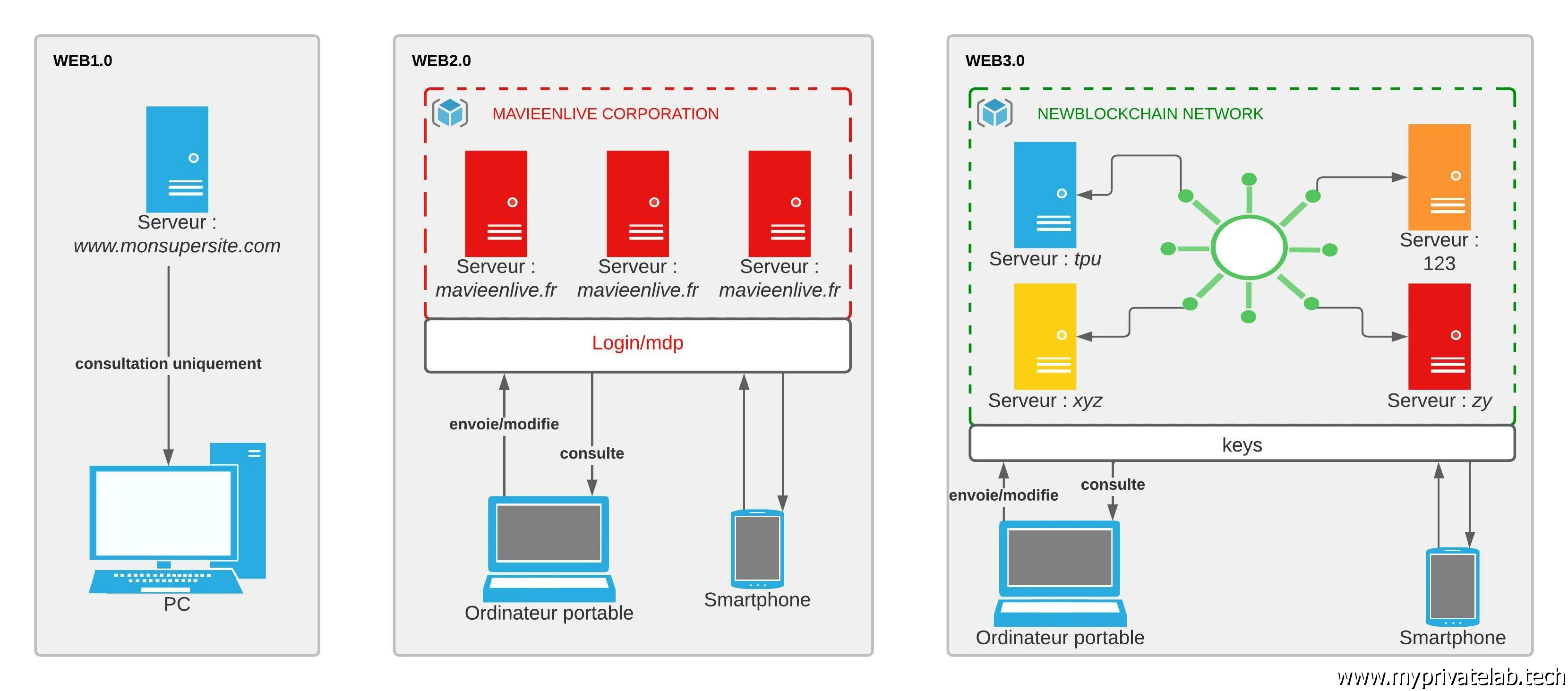
Click the image to enlarge.
In practice
This involves building applications that run on nodes within a network whose members belong to different entities, executing open-source code free of rights. There can be multiple networks, specialized or otherwise, with potential bridges between them if necessary. Authentication within these networks is done via a combination of a private key/public key, rendering the traditional username and password obsolete, allowing users to avoid providing personal information if it is not required.
To put it simply: several interconnected blockchains serve both to host data and to execute tasks. Social networks could still exist, but be completely independent of any specific company. Running a node by an actor is encouraged through gains in the form of tokens, which increase in value as the network is used. These same tokens can also be used to establish governance for deciding on the project's roadmap, with each token holder being able to propose improvements and participate in voting on features to implement.
In essence, Web 3.0 is the implementation of concepts that are currently emerging around blockchain and cryptocurrency: decentralization, tokenomics, DAO (Decentralized Autonomous Organization)...
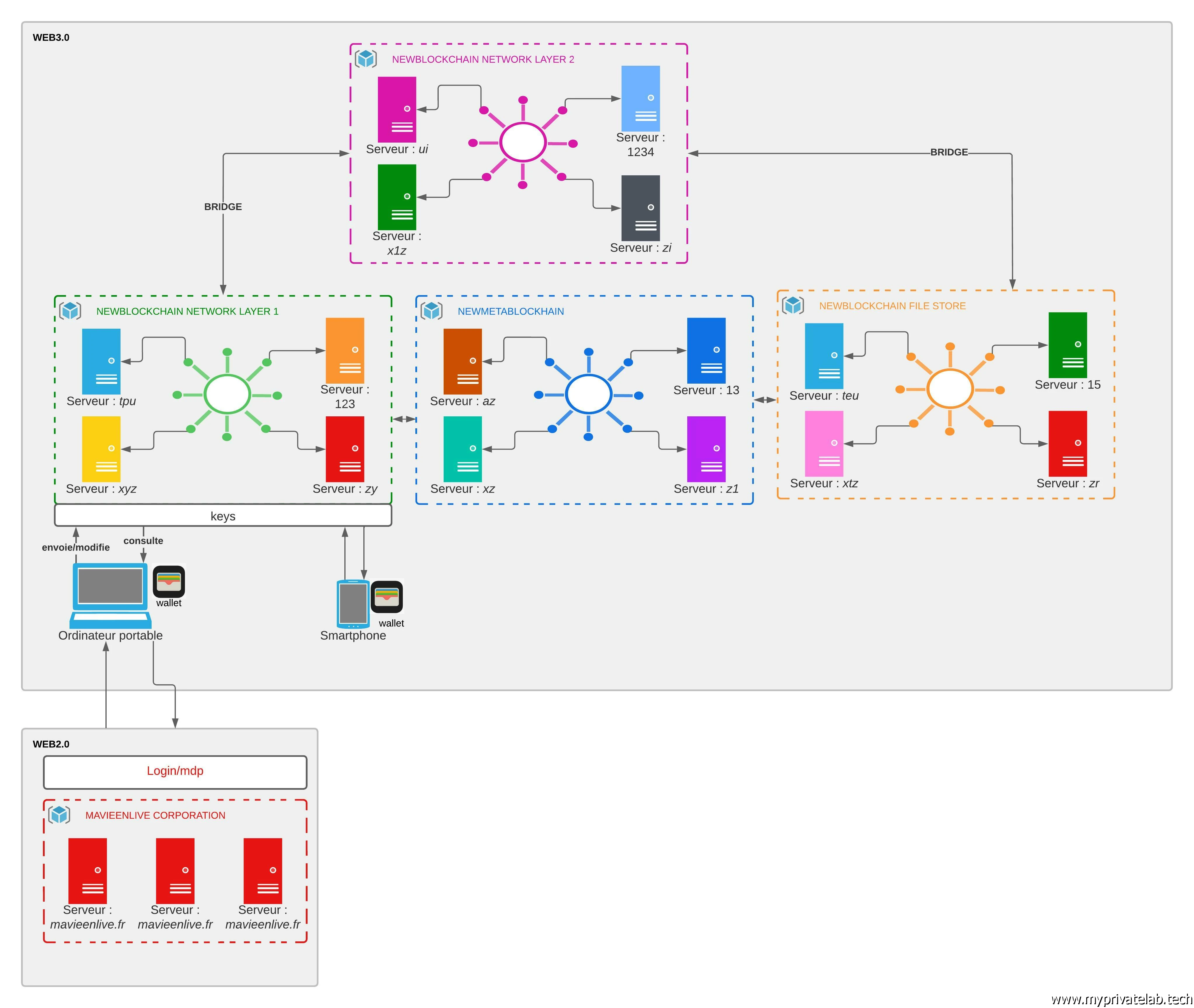
Click the image to enlarge.
We are even starting to see the emergence of "layer" logic. If some are familiar with the OSI model for describing how a network functions, I cannot help but find an echo of it in what is appearing today on Web 3.0.
Indeed, in the ideal world, we should be able to rely on networks that are both decentralized, secure, and scalable. However, it is very difficult (or even impossible) to implement these three constants with the same level of performance. Improving one often means diminishing the other two. This is known as the blockchain trilemma.
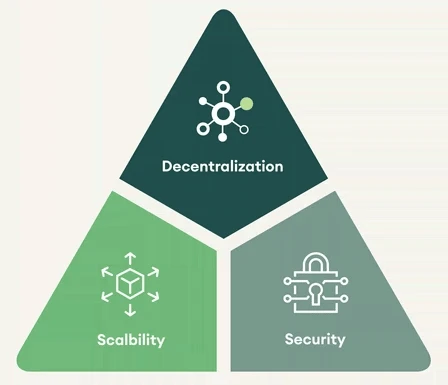
Click the image to enlarge.
To try to address this issue, Web 3.0 is adopting a modular approach based on the layering of components, similar to the OSI model.
We now find "Layer 0" networks such as Polkadot or Cosmos, which are responsible for interconnecting networks from the upper layer with each other. The focus is on decentralization and security, without any particular specialization. Protocols for exchange are being developed that can be freely implemented and adopted by blockchains operating above them.
Then come the Layer 1 networks, such as Ethereum, Solana, Cardano, and Bitcoin. This is the most developed layer today, as it was historically the first on the market. Depending on the blockchain's functionality, we can find more or less advanced features. Bitcoin, for example, remains focused on transferring value, while Ethereum provides programmability for executing more complex code (the famous Smart Contracts). However, overall, the priorities remain focused on security and decentralization
Layer 2 networks have arrived more recently, particularly on Ethereum. These networks come in various types and combine different mechanisms. They are often more centralized than Layer 1 networks, but they are frequently faster with significant transaction speeds and, most importantly, much lower usage costs. Indeed, executing code and especially storing data on Layer 1 networks is becoming increasingly expensive as the network is used. The mechanisms for synchronizing a large number of nodes around the world, guaranteeing very high information availability and resistance to attacks, are complex...and therefore expensive. Layer 2 networks allow aggregating a large number of transactions and compressing information before sending it to Layer 1 networks. Therefore, there is initially more risk, lower resilience, and a risk of censorship, but once the data is recorded on Layer 1, we regain the advantages of these networks.
Layer 3 networks are still in their early stages; we are talking about highly specialized networks designed to perform a specific type of action. This could involve processing information from a video game or running mechanisms specific to an application. Performance and cost are paramount, and over time, the data will descend into lower layers...or not, depending on the developers' wishes and the underlying need.
It is worth noting that some projects, such as Solana, continue to focus on an approach based solely on Layer 1. The underlying principle is that it remains technologically possible to build a blockchain that can be good in all aspects.
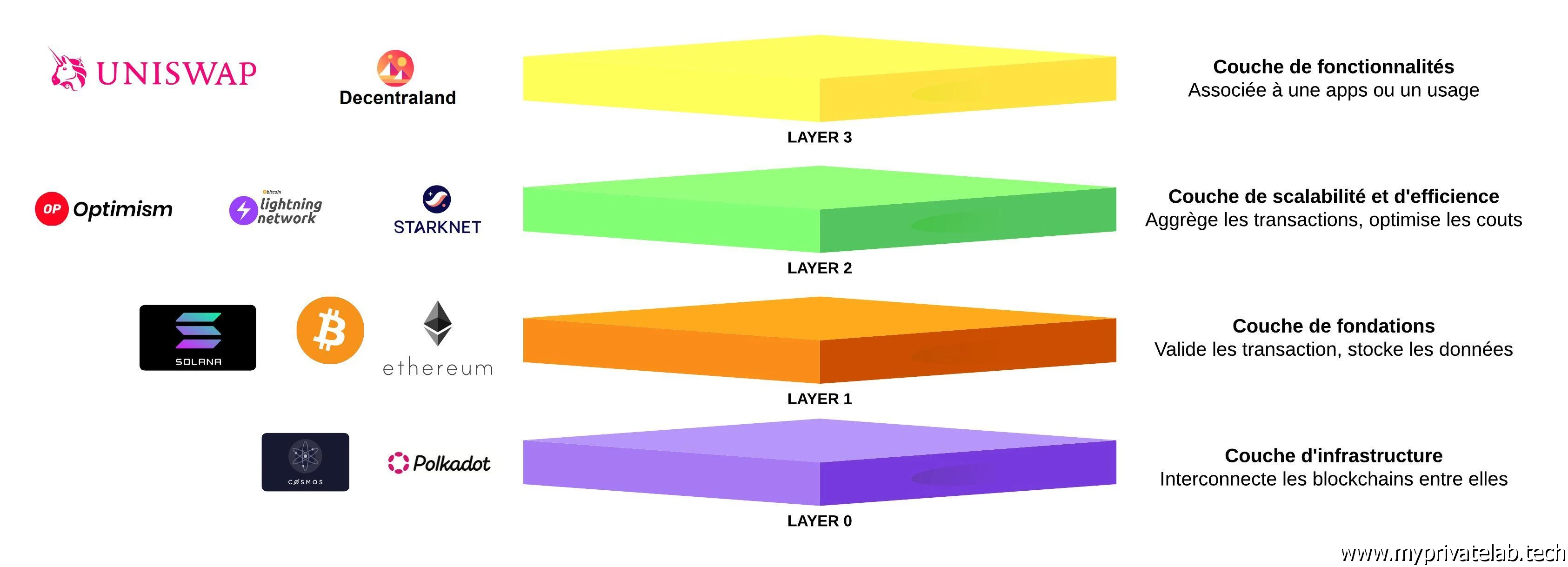
Click the image to enlarge.
Strengths and weaknesses
On paper, this seems promising, but in practice, it remains complicated.
Centralization is not without its advantages: it provides reassurance for some, it is technically simpler to implement and more efficient (the more decentralized you become, the more nodes there are, and the more difficult and time-consuming it becomes to reach consensus). It is also easier to regulate. Indeed, anonymity and the use of networks that belong to no one...but who do you complain to when things go wrong or when some people take advantage of vulnerabilities in implemented protocols to steal data or compromise a network?
Security is also a major issue surrounding the internet, and Web3.0 relies on certain principles and technologies that are still relatively new, and we lack sufficient experience with them.
While the concept of Web 3.0 is fairly well described, it is far from mature as of the date this article was written.
Its use remains complex and requires further technical development. The use of layers certainly helps to begin providing a solution to the blockchain trilemma, but it currently results in a very poor user experience (hence the persistence of some projects like Solana in sticking to a Layer 1 approach).
The explosion of networks of all kinds, and the mixture of serious and promising projects with bullshit projects that are simply riding the wave, makes it difficult to know what will remain and what will disappear. Who remembers internet service providers like Tiscali, AOL, Club Internet, Alice, or services like MSN, Caramail, Yahoo, Lycos...? It is very likely that Web 3.0 still has a major cleanup ahead of it before it truly proves its relevance.
There is also a significant risk that Web 3.0 will give rise to other internet giants, or that existing ones will dominate it. If 500 servers participate in a project, but all 500 belong to the same entity, directly or indirectly, then sticking with a traditional model might be better. Some blockchains boast of having more than 1000 servers managed by as many different people… But when you look closer, you realize that 90% of these nodes are running on AWS or another public cloud provider… which could decide overnight to terminate the instances.
Similarly, if governance through tokens means that whoever holds the most tokens has the most decision-making power in the project, it leads to centralization of decisions.
On the other hand, it is highly likely that Web 2.0 will evolve over the years and incorporate aspects of Web 3.0. For example, an NFT might not just be a JPEG sold for far too much money, but could instead be a digital version of a diploma, where you can verify the issuing organization, which is linked only to the owner of a private key and can be directly consulted by job sites to ensure the validity of a candidate's CV.
Imagine a recognized school issuing proof of passing an exam via an NFT, which would be an unforgeable cryptographic proof linked only to each student's private key. Each student who receives the NFT could indicate it on a Web 2.0 site like LinkedIn. The latter, by consulting the blockchain, could verify that the issuance of the NFT was indeed done by the public address associated with the school and thus ensure that the person has passed their exam.
Authenticating in a game could be done directly with something equivalent to a "Wallet," using the user's private key, which could store their inventory and progress through levels on a public blockchain. This would facilitate the fight against cheating and potentially enable interaction with other games or access to activities/objects in the real world (winning a virtual object could, for example, allow you to win a physical object).
While the private key/public key mechanisms associated with seed phrases used in blockchains remain complex for some, alternatives are emerging, such as account abstraction, which allows us to return to more traditional authentication methods while still benefiting from interaction with Web 3.0 networks.
Conclusions
While Web3.0 is primarily a marketing buzzword that many projects are using to try and sell their innovations, it remains true that the internet as we know it today is evolving, as it always has. Digital technology is an integral part of our lives, and this raises some concerns about security and the use of our data. It is becoming necessary to introduce the concepts of scarcity and ownership into the digital world in order to fully realize the digitalization that has been underway for many years.
We are trying to replicate certain principles from our real lives in the virtual world, such as ownership, transferability, and privacy. Web 3.0 is supposed to help with this, but nothing is yet set in stone, and everything can still change! However, I remain deeply convinced that behind the "hype" there are genuine innovations. It is not impossible that some brilliant developers are currently building the standards of the internet of tomorrow!