Bitcoin part 1: a story of consensus
- Bitcoin sparks controversy and confusion; the angle taken here is technical.
- Vocabulary: Bitcoin (the protocol and network), bitcoin (the currency) (BTC).
- Proof of Work (PoW) consensus and the role of mining.
- Why attacking the network doesn't make economic sense.
Introduction
As of the writing of this article, Bitcoin is once again receiving a lot of media attention.
Some television channels, along with various news articles, offer their opinions and explanations on the subject...often with a great deal of confusion and generalizations.

Click the image to enlarge.
Personally, this is a topic that fascinates me. Technically first, then ideologically. But it took me time and a lot of reflection to gradually form my own opinion and understand a little better how this ecosystem works...while always continuing to learn.
For over 10 years now, Bitcoin has been the source of controversy: praised by some, cursed by others...the advantage is that today you can easily find a lot of information about its operation, its origins, and its principles.

Click the image to enlarge.
But I also wanted to offer my perspective on this topic. Of course, I have no legitimacy or reputation to justify it, but since Bitcoin is, for me, in some way a symbol of freedom, I am free to write about the subject...and all the better if a few internet wanderers who arrive here by chance can find information that they will consider useful...or not.
Please note, I am not an activist. My goal is not to rally anyone to a particular cause.
I simply want to try, and especially through technical explanations, to explain what a simple tweet or a few minutes of commentary on a talk show cannot convey about Bitcoin.
I will also not go into detail about everything that could relate to Bitcoin. I will simply address some fundamentals in order to move on to possible technical applications.
The purpose of this site is experimentation, and my goal is to share some tools, hardware, and applications that allow you to experiment with Bitcoin, primarily out of pure curiosity and a passion for technology.
A little vocabulary
"B"itcoin with a capital 'B' or a lowercase 'b'
To begin, let's make sure we are precise about the terminology. Bitcoin is a generic term that actually covers three important concepts:
- The cryptocurrency: named bitcoin with a lowercase b, and abbreviated as BTC. It is a digital currency. It is used to exchange value (the value that the market is willing to give it). It has no physical existence, and its issuance is limited to 21 million BTC. 1 BTC can be divided into 100,000,000 smaller units, called satoshis (or sats). This means that the smallest unit of BTC is 1 satoshi, which is 0.00000001 BTC.
- The network: named Bitcoin with an uppercase B. It is a set of interconnected computers (or nodes) of various types, responsible for validating and maintaining the transactions associated with the bitcoin cryptocurrency. This is the technical infrastructure.
- The protocol: also named Bitcoin. It is a set of rules that can be implemented within software, which define how bitcoin transactions are managed and the mechanism for issuing new BTC.
Example: I have 0.000025 BTC
Example: The Bitcoin network is decentralized.
Example: The Bitcoin protocol is open source.
The blockchain
Finally, there's the famous blockchain. Often confused with Bitcoin. In fact, the blockchain is a completely separate and independent technology from Bitcoin.
In short, a blockchain is a replicated database that exists as many times as there are nodes (computers) that execute it, and whose evolution is subject to a consensus shared by these nodes.
It consists of blocks linked together in chronological order. These blocks host data that can be of various natures and are mathematically linked to each other through cryptographic algorithms. This means that modifying one block is not possible without causing a modification of all the blocks that precede it.
It turns out that, for its operation, the Bitcoin network relies on blockchain technology. The data in the blocks is used to store transactions made in BTC.
In summary
The Bitcoin ecosystem consists of a digital currency issued on a blockchain executed on a network composed of nodes, the rules for issuing and managing transactions of which are described in an open-source protocol.
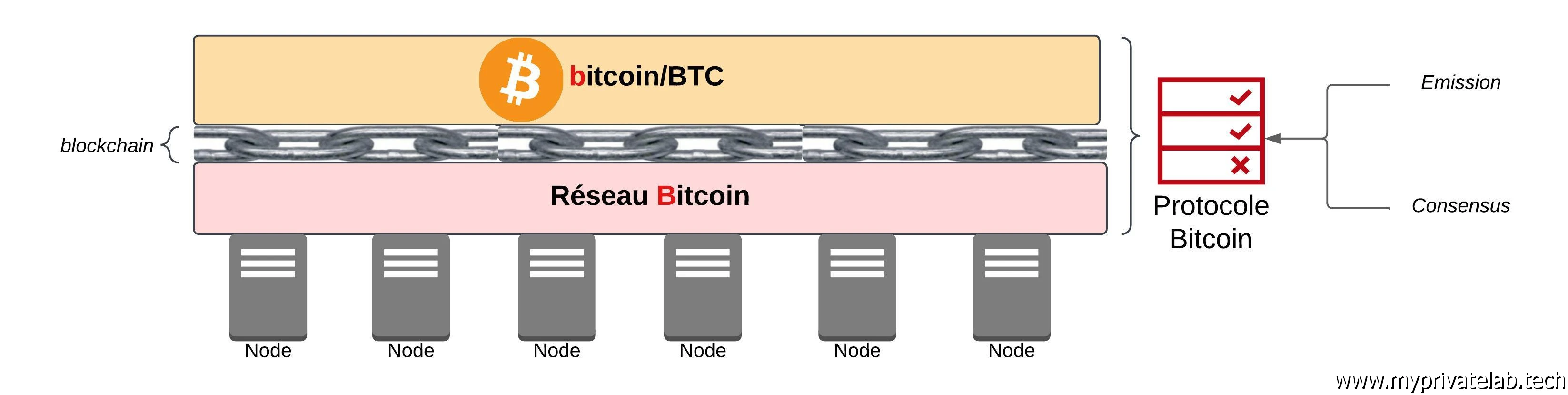
Click the image to enlarge.
PoW: Proof of Work
We continue with the fundamentals and the famous proof of work, or PoW: Proof of Work.
Byzantine generals problem
To understand this, we first need to discuss a well-known problem in cryptography: the Byzantine generals' problem. This is a theoretical concept in computer science that illustrates the challenge of achieving consensus in a decentralized system where some participants may be malicious.
It was formulated in 1982 by Leslie Lamport, Robert Shostak, and Marshall as part of research on fault tolerance in distributed systems.
Imagine several generals of an army surrounding an enemy city. They must decide whether to attack or retreat. But for this to happen, they must first agree so that the army acts in a coordinated manner. The problem is that the generals are located at different points around the city and cannot communicate directly. They must send messengers across the battlefield to exchange orders in order to reach a common agreement.
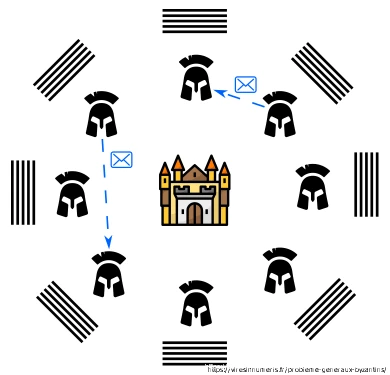
Click the image to enlarge.
The risk is that the messengers may be captured, that messages may be modified, or worse, that one of the messengers, or even a general, may become corrupted and spread false information.
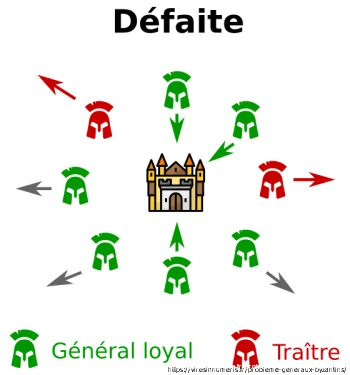
Click the image to enlarge.
In the absence of a higher-level decision-maker, how can we ensure that consensus is reached among the generals, and that only the honest generals participate in the battle strategy, eliminating the traitors?
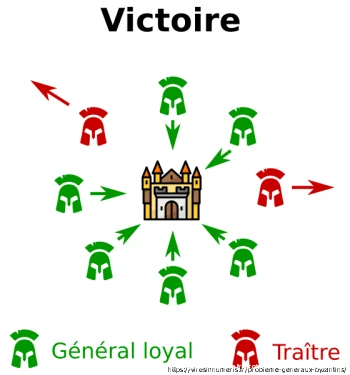
Click the image to enlarge.
(The three images above are taken from the website viresinnumeris.fr)
It follows that mathematically, at least two-thirds of the generals must be loyal and have the correct information.
This concept is still used today to address problems of fault tolerance and data reliability.
This is particularly a challenge in so-called decentralized systems, one of the promises behind blockchain technology. A brief aside: a blockchain only has value with a minimum number of participants. Even though technically a blockchain can run on a single node, its usefulness is completely null because, in that case, a traditional database would be much more efficient and effective.
The number of nodes from which one can determine the value of maintaining a blockchain structure depends on the use case.
There are two cases:
- A public blockchain, such as the one associated with Bitcoin. This means that anyone can participate in the blockchain without authorization, provided they have the necessary equipment and obtain the associated software. In this case, it is ideal to have as many nodes as possible, as the blockchain becomes more secure as the number of nodes increases. Still referring to the Byzantine generals problem, if 2/3 of the generals need to be corrupted, this implies that the more generals (nodes) there are, the more generals need to be corrupted... but reaching consensus can then become more complex (the more generals (nodes) there are to "synchronize", the longer it may take). This is related to the blockchain trilemma that I mention here.
- A private blockchain, dedicated to actors from the same sector. This will depend on the specific sector and the desired goal. This can be done within partnerships or when private organizations decide to base the tracking of their transactions on a blockchain in order to maintain neutrality and/or eliminate an intermediary deemed too expensive. In this case, participation in the blockchain is subject to authorization, and it is possible to imagine a smaller number of nodes... but it must be worthwhile and not just follow a temporary trend.
In all cases, we seek to prioritize decentralization.
This implies a large number of participants in a network without any notion of hierarchy. In theory, this protects against censorship or manipulation of the network by a central organization.
But how can we ensure that all participants play fair and do not try to make the system fail or modify it for their own benefit?
The art of circumventing the problem
Well, so far, there is no perfect answer. In its current state, it is even impossible to guarantee this.
However, we can create a system in which it becomes very difficult for one or more malicious actors to sabotage the plan.
We make it so complicated that it becomes economically (in terms of time, money, and energy) more expensive to manipulate the outcome of the "war" to their advantage than the gains it could bring.
Using a different analogy, it's like thieves spending more money and resources to open a safe than the amount of money inside. And that's where all the subtlety...and magic of the Bitcoin protocol lies.
Its (or its creators', which we will discuss in more detail later) primary goal was not simply to make it impossible to corrupt the network, and therefore the digital currency it hosts, but to make participating in the network more rewarding than trying to corrupt it.
This is where the famous "Proof of Work" (PoW) comes into play.
Node type
Within the Bitcoin network, there are primarily two types of nodes.
- Nodes that host the blockchain. These exist in two categories.
- Full nodes: They download and store a complete copy of the blockchain
- Lightweight nodes: They only download a portion of the blockchain.
- Mining nodes: These are the nodes that participate in creating new blocks. They are the ones who generate (mine) new BTC (via the rules defined in the Bitcoin protocol) and process new transactions. This task requires increasingly more resources as the network grows (in the same way that it becomes harder to find gold as it becomes scarcer).
In both cases, their role is to provide existing data to those who request it and to participate in ensuring the resilience of transactions. They do not create blocks but ensure that all existing and newly proposed blocks are always valid and conform to the protocol. This is a relatively simple task that does not require significant resources (other than a large amount of disk space for full nodes). There is no reward provided for this type of node.
There are other types of nodes, but we will not discuss them here. Here is a summary of the possible nodes on the Bitcoin network.
| Node type | Main role | Blockchain storage | Security | Example of use |
|---|---|---|---|---|
| Full Node | Validates all transactions and blocks | Complete copy | Very high | Bitcoin Core, network maintenance |
| Lightweight Node | Fast access to the network without downloading everything | Partial | Medium | Mobile wallets |
| Mining Node | Creation of new blocks via proof of work | In conjunction with a full node | Very high | Professional mining |
| Archival Node | Stores all historical blockchain data | Massive | Very high | Research and analysis |
| Routing Node | Facilitates payments on secondary layers | No direct storage | Medium | Lightning Network |
Each type of node has a specific role, but they work together to ensure the security, decentralization, and smooth operation of the Bitcoin network.
Proof-of-work involves miners (mining nodes) and requires very specific hardware (ASICS Application-Specific Integrated Circuits) dedicated to this activity.
Mining principle
The goal is to solve a complex mathematical calculation. The first one to solve the calculation earns the right to record the latest transactions and generate the new block. They will be rewarded in two ways.
- They will receive the number of BTC associated with the issuance of the block. The protocol defines the emission of new BTC with each creation of a block. This number is halved approximately every 4 years, gradually reducing the number of BTC produced until it reaches zero once the 21 million BTC have been issued.
- They will receive the fees associated with the transactions recorded in this new block. Anyone who wants to use the Bitcoin network to make a transaction must pay fees that fluctuate depending on the level of network usage. The more the network is used, the higher the fees. Once the 21 million BTC have been issued (currently expected in 2140), the fees will be the only source of revenue for miners.
This famous mathematical calculation requires computing power, so it will consume electrical energy through the use of specific computer equipment.
If you want to earn bitcoins through mining, you need to prove your commitment to the network by providing computing power. The more computing power you provide to the network, the greater your chances of solving the calculation before others, thus generating a new block and recording the new transactions, and therefore earning the associated BTC: this is proof-of-work.
It's like solving a mathematical puzzle; everyone tries to find the solution, and the first one to find it is rewarded.
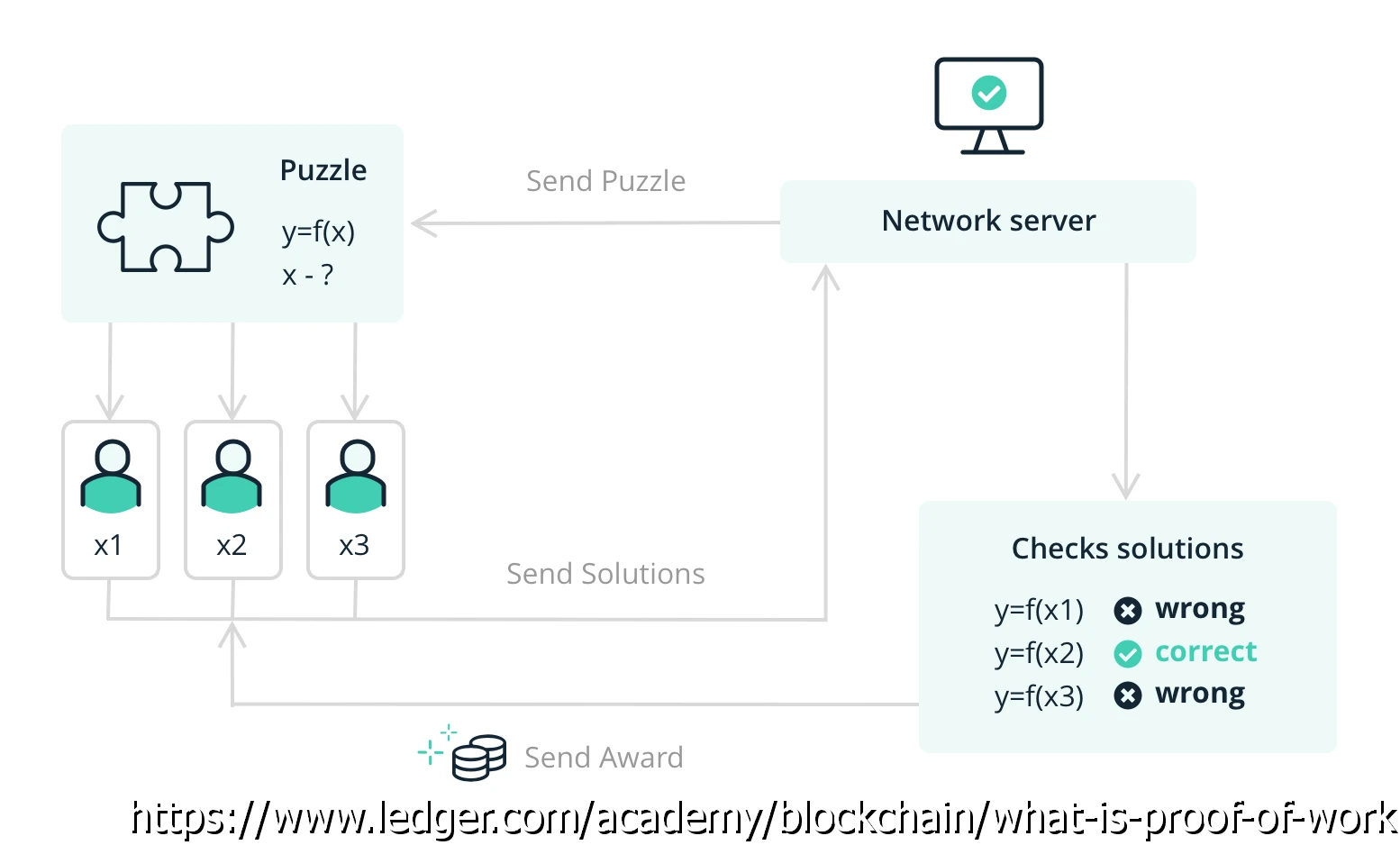
Click the image to enlarge.
Mining difficulty principle
The magic happens because the more miners there are, the higher the difficulty of the calculation becomes. And vice versa. We are talking about the mining difficulty. This is not static. The goal is for the calculation to always be solvable approximately every 10 minutes. Therefore, every 10 minutes, a challenge is launched to determine who will produce the next block and record the transactions related to BTC exchanges.
It's like increasing the number of digits to find in the lottery as there are more new players, but with the goal of having a winner in each draw...and if several people find the combination, the first one to register their ticket wins the prize.
Mining power is expressed in TH/s, which is the ability to perform a trillion calculations per second. Be aware that these are calculations dedicated to finding the solution to earn the right to create the block. These are hash calculations: this is the famous hashrate.
Having 1 TH/s corresponds to being able to test a trillion possible solutions per second in order to hope to find the solution to the equation proposed by the network. To optimize operations as much as possible, these are the famous ASICs mentioned previously that do the work. These are specialized chips that, unlike our computer CPUs, can only do one thing: they can only "mine", and only on the Bitcoin network (or other networks that use the same hashing algorithm (SHA256) dedicated to solving the algorithmic challenge).
You can follow here the evolution of the network's power. The higher this number, the more miners there are on the network, and the higher the mining difficulty. Conversely, if the number decreases, it means that some miners are withdrawing because their profitability is no longer guaranteed...but the mining difficulty becomes easier, which may encourage others to return to the network since there is a greater chance of succeeding in the challenge...etc...
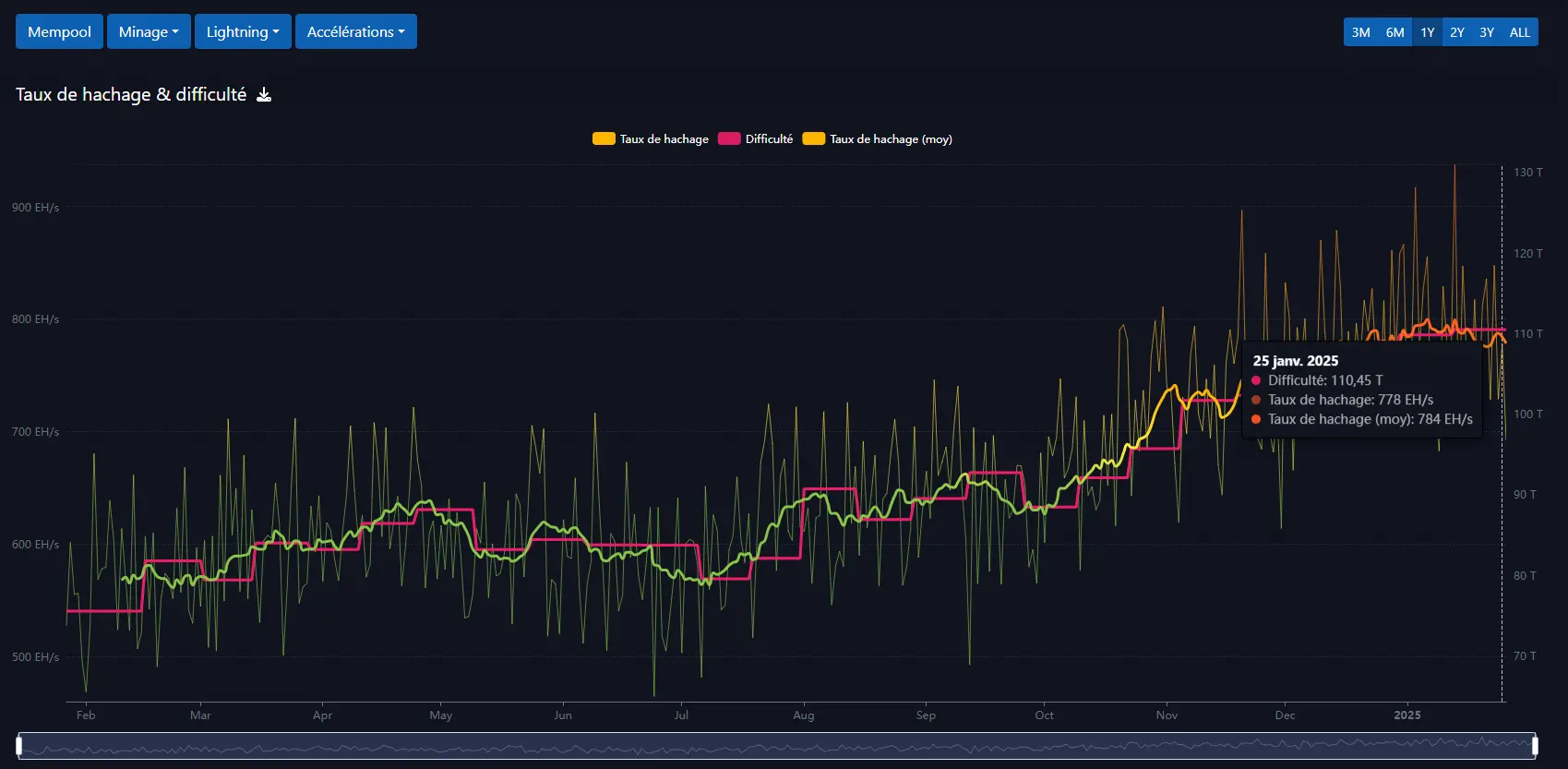
Click the image to enlarge.
As of January 3, 2025, the Bitcoin network reached a new record for computing power, with a hashrate exceeding 1,000,000,000 TH/s...
Let me warn you now, mining at home on standard hardware has become impossible...at least if the goal is to make money...but I will talk about this in more detail later
Difficult to find but easy to verify
In addition to this adaptability of the mining difficulty, which ensures a regular block creation and maintains an adaptation of the equation to the evolving hardware of miners, the proof-of-work used by Bitcoin is simple to verify. While it requires ASICs and a large number of operations to find the solution to the calculation submitted by the network, once the solution is found and proposed by a miner, it is extremely simple and fast to verify whether the solution is correct...and therefore to approve the block submitted by the miner.
Nakamoto consensus
This proof-of-work, along with all its associated logic, forms what is called the Nakamoto consensus…and this is truly the first time that a response to the Byzantine generals problem has been implemented on a large scale.
Regardless of any economic considerations, it is one of the major technological revolutions brought about by Bitcoin.
The consensus mechanism is named after its creator, the famous Satoshi Nakamoto, who is at the origin of the Bitcoin ecosystem. I will not elaborate too much on this topic, as it is probably one of the most fascinating aspects of Bitcoin: we still don't know who Satoshi Nakamoto is.
He was the author of the white paper on Bitcoin, but he never revealed his identity and disappeared completely from the public eye in 2010. Since then, many hypotheses have emerged, fueling some conspiracy theories that are popular on social networks. For some, it may not be a single person, but a group of people. This is one of the strengths of Bitcoin: by not being able to judge the personality of its creator, we can only focus on his work and what he has produced technically.

Click the image to enlarge.
Although not the ultimate solution to the Byzantine generals problem, the Nakamoto consensus, since January 3, 2009, the date of the mining of the first block, demonstrates the ability to share information within a decentralized network hosting a blockchain as part of an open-source protocol.
This is the most reliable solution found so far for addressing the Byzantine generals problem, making the Bitcoin network one of the most secure computer networks in the world (if not the most secure). The network has been running and growing for over 10 years without ever being hacked. It has only experienced two minor incidents since 2009 and offers the highest level of availability compared to Google's search engine.
So, why does Nakamoto's consensus mechanism achieve this feat? Simply because, in addition to combining cryptographic principles with blockchain technology and utilizing proof of work, it also relies on game theory.
Game theory is a branch of mathematics that analyzes the decisions made by individuals (players) in situations where their gains or losses depend on the actions of others.
With this proof-of-work system, it always becomes mathematically more advantageous to participate in the network (to mine BTC) than to try to destroy the network.
Bitcoin mining has become an industrial activity. Attempting to generate fake blocks and manipulate transactions would involve investing an astronomically large amount of money to acquire enough computing power and ensure that you mine the blocks before everyone else.
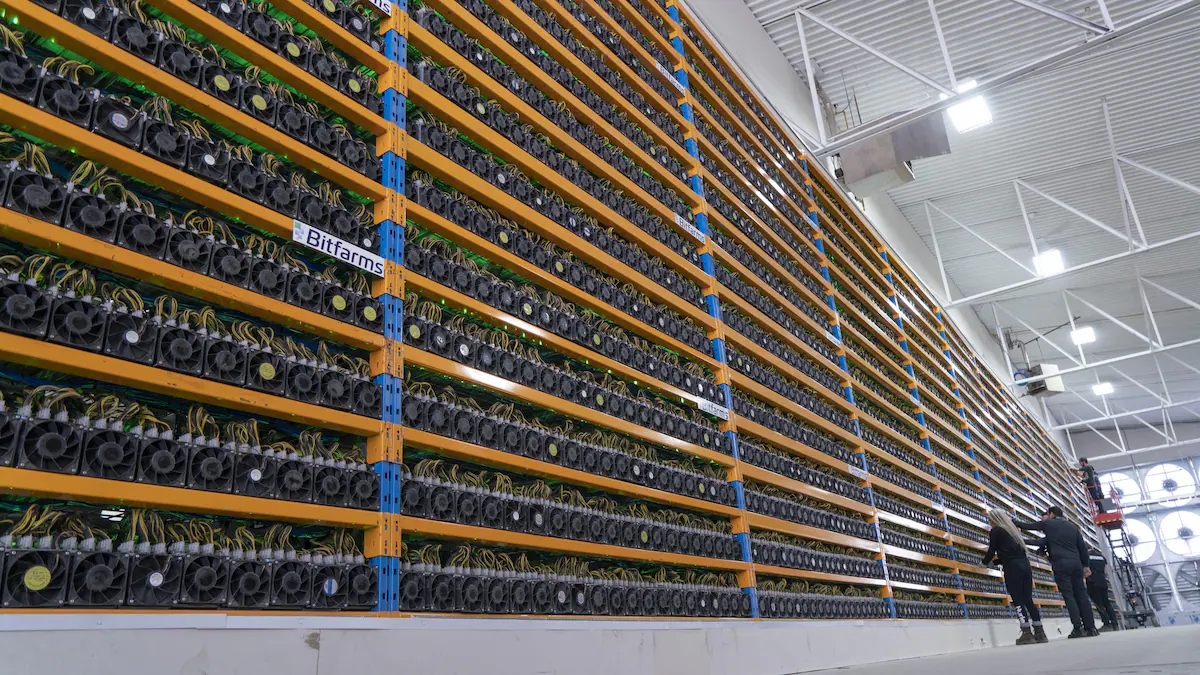
Click the image to enlarge.
It is true that the mathematical calculation presented to the miner has no direct interest. We are not trying to solve a scientific problem. It's an equation whose difficulty is proportional to the number of miners. Solving it brings absolutely nothing other than being the first to mine the next block and pocketing the associated rewards.
But this energy consumption, inevitably induced by proof of work, which is so criticized, is at the same time the best guarantee that no one can take control of the network. It's a protection against any actor who would seek to falsify transactions. If someone really has significant resources to try to do this, it is much more advantageous for them to contribute those resources to the network rather than working against it.
If we think about it, what interest would there be in destroying the Bitcoin network other than ideological reasons? If the Bitcoin network were to fail tomorrow, the associated digital currency would have no value.
If an actor managed to manipulate transactions, one way or another, this would eventually become apparent because all transactions are public. I haven't mentioned this until now, but not only is the protocol open source; all transactions are visible and can be verified by all nodes connected to the network (there are over 20,000 nodes distributed (unevenly) in more than 100 countries). Therefore, this actor would have put enormous resources in place to gain no benefit at the end?
I won't delve into the environmental debate surrounding Bitcoin mining. It's a very sensitive topic that deserves dedicated articles. Of course, Nakamoto's consensus mechanism, through its use of Proof-of-Work (PoW), is a huge consumer of energy, but it serves a purpose and has uses.
Furthermore, it's important to understand that now that Bitcoin mining has become an industrial activity, it operates according to the laws of profitability. A miner's main expense is electricity; their activity only makes sense if they earn more in BTC than they spend on energy. They are constantly searching for the cheapest possible electricity... and increasingly, the least expensive electricity is green energy and/or unused/wasted energy.
In response to the argument that Bitcoin's electricity consumption is greater than that of a country, there is now the counter-argument that it accelerates the adoption of green energy and can help with the regulation and development of electrical grids, which Bitcoin mining can offer.
In short, the idea that the Bitcoin network could be something other than just an enormous energy sink is starting to gain traction.
Conclusion
It's on this statement that some environmentalists might find provocative that this first article about Bitcoin ends.
More will follow, but it was already important to highlight the basic functioning of the Bitcoin network and to have a minimum understanding of the technical implementation of Bitcoin, and specifically its consensus mechanism.It's important to differentiate between the Bitcoin network and the BTC digital asset that circulates within it.
I haven't even mentioned the issue of double-spending here, because we are already dealing with the financial application enabled by Bitcoin technology. I will have more opportunities to talk about this topic in the next article, which will be more focused on BTC transactions.
We can discuss Bitcoin extensively without having to mention speculation or trading. I don't deny that it is a part of it, but there are other perspectives we can use to discuss Bitcoin
And for everyone who is closely or remotely interested in technology, it must be noted that Bitcoin is extremely interesting to study. I hope to further support this argument with the article that follows.