RealT… is it really WEB 3.0?
- Update from 05/07/2026: The RealT adventure is over; the assets are being liquidated.
- RealT offered to invest in fractions of tokenized real estate properties.
- Principle, advantages and disadvantages, technology and ecosystem.
- Lesson: Tokenizing a real-world asset does not eliminate the risks associated with that asset itself.
IMPORTANT: update 05/07/2026 - RealT is finished
The RealT adventure is over. Due to legal issues, particularly with the city of Detroit, and various management problems, all of RealT's assets will be liquidated. Personally, I lost a significant sum on this project, but I was aware of the risk from the start. Tokenizing a real-world asset like real estate does not eliminate the risks associated with the underlying asset itself. It wasn't the tokenization that failed, but the management of the rental properties. RealT was a pioneer in the field of "Real World Assets," but it failed to scale.
It is not for me to say whether the founders failed to fulfill their commitments or if there was an intention to defraud users. Everyone is free to form their own opinion.
I simply note that, even though the experiment did not succeed, it still paved the way for other projects. I hope these will be successful. I remain convinced that tokenization has a future and that, although Web3 has suffered from its marketing, it remains a field where many things can be done with new uses to come. I have decided to leave the article online so that those who are interested can discover its concept and idea. However, it is very important to consider that the project is over and that it is no longer possible to participate in it. Be careful of hypothetical scams and other attempts to exploit the topic.
Introduction
Click the image to enlarge.
It is common to consider WEB 3.0 as a marketing buzzword, a new whim of certain speculators eager for projects with no substance but full of promises.
However, as I have described in this article, Web 3.0 also has a more concrete side, with innovative and promising concepts.
RealT aligns with the logic of leveraging new technologies and approaches to disrupt more traditional markets, such as real estate.
Before proceeding, please note that this article is not investment advice. It reflects only my personal opinion and aims to present a project illustrating WEB 3.0.
Origins
RealT is a platform for tokenizing real estate assets offered since 2009 by the Jacobson brothers. Jean Marc and Rémi have extensive experience through numerous projects and companies, particularly in their home country of Canada.

Click the image to enlarge.
It was notably in Montreal that they built a real estate empire by consistently applying the same principle: buy when prices are low, sell when they are high, and collect rent in the meantime. While this may not seem very original, they built their reputation by focusing on specific areas, often considered abandoned or destined to disappear. By concentrating on a market and capitalizing on overlooked neighborhoods with high potential, they achieved significant success.
By nature innovators, they also closely followed the Bitcoin project, becoming involved in mining and promoting the democratization of internet currency. This is how they became acquainted with blockchain technology and began considering the combination of their real estate expertise with the new technological capabilities offered by what would later be called WEB 3.0.
The principle
Click the image to enlarge.
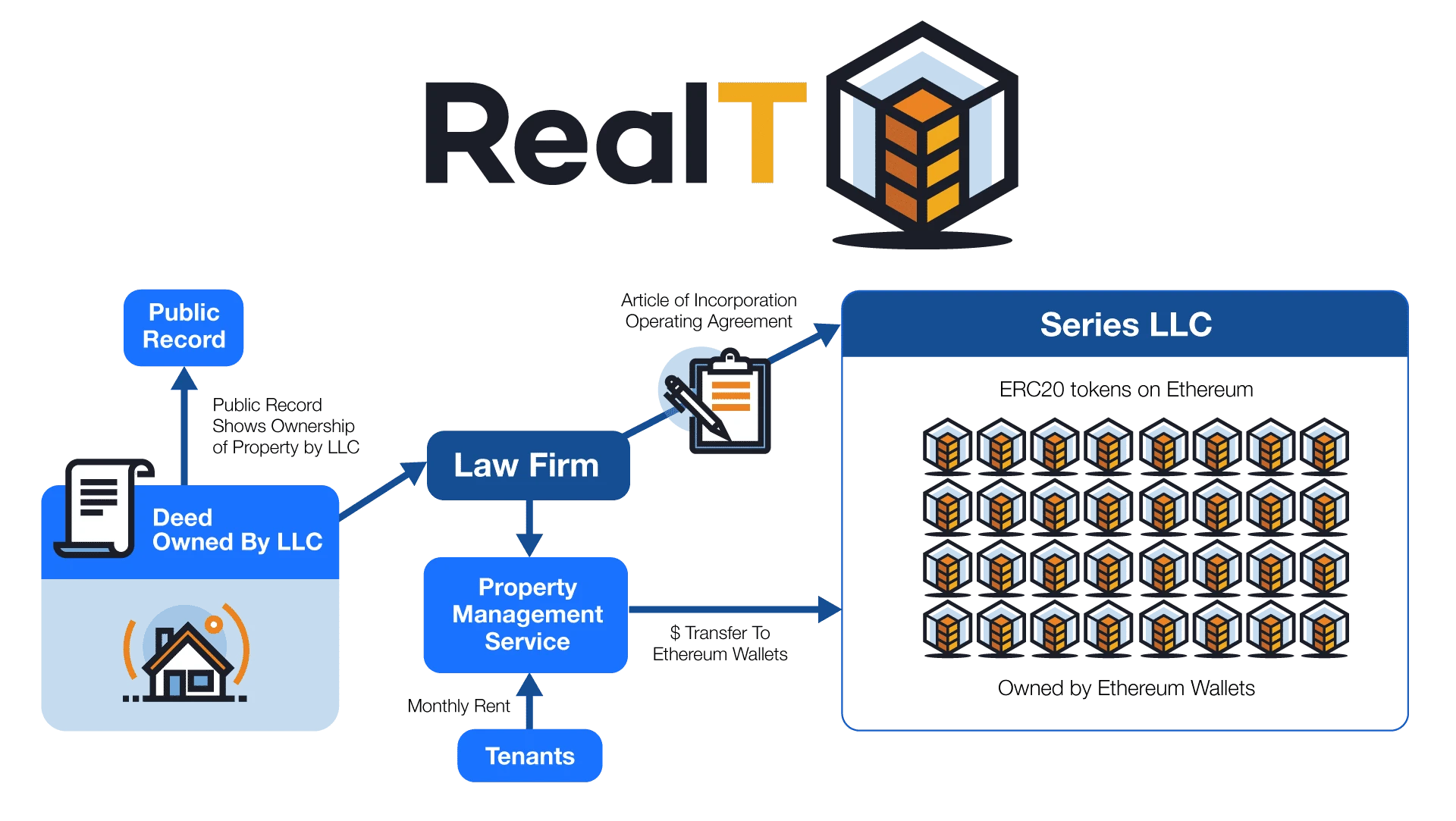
In summary, when you buy a RealT token, you are acquiring a share of a company whose sole capital is represented by the associated real estate and whose only revenue consists of the rent received for that property.
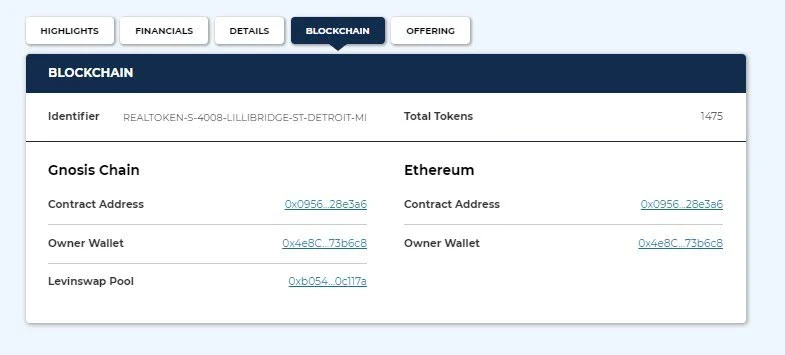
All of this is controlled by the blockchain, where each property is linked to a smart contract that defines the number of tokens and their distribution.
Your share of the rent is received every Monday in stablecoin, either through your account on the website or directly to the address of your wallet.
Therefore, you can invest in real estate, receive rental income while staying at your computer, and manage your returns and property titles directly within your preferred wallet.
Advantages/Disadvantages
On paper, this seems fantastic...and it is...but it's not without its flaws.
RealT primarily invests in the United States, specifically in Detroit, the first American city to declare bankruptcy in 2013.

Click the image to enlarge.
This may be concerning, but if you go back a bit further in the article to learn more about the founders, you will understand that the approach is to invest in areas with potential rather than locations already considered top-tier (and therefore very expensive).
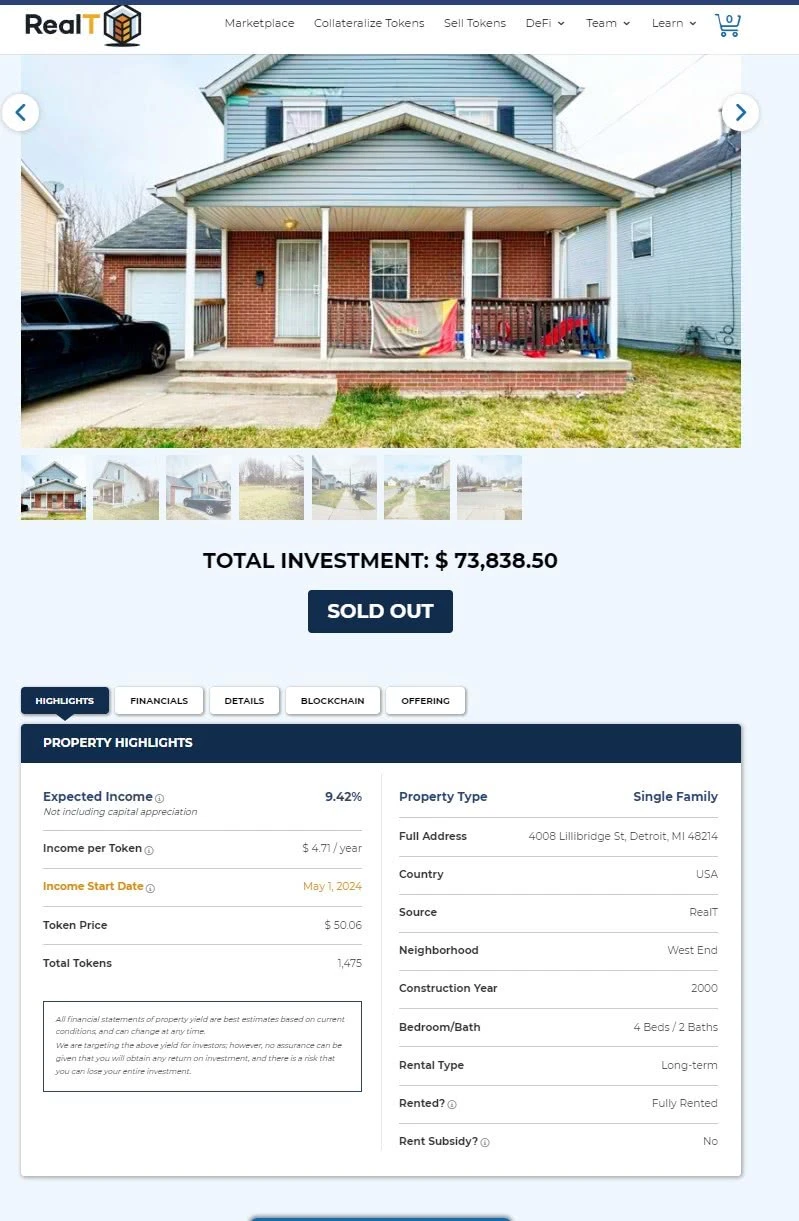
The fact that they focus on properties with lower rents, often involving government assistance, nevertheless allows for returns of around 10%, sometimes more, and sometimes less. This can vary over time, but you will find the details for each property when it is put up for sale.
Click the image to enlarge.
Click the image to enlarge.
These sales typically happen very quickly, and it's not uncommon to see all the tokens sold out in a few minutes...and to be frustrated by not being able to acquire any. Note that purchases can be made with a credit card (but this involves fees) or directly in stablecoin.
Here are some interesting facts to give you a better understanding of RealT's purchasing strategy. You will often find RealT properties in areas close to each other, sometimes covering entire neighborhoods. In fact, with each acquisition, there is always a fund set aside from the purchase price for renovating the building. Each property that is renovated indirectly improves the neighborhood, so the more you renovate in the same area, the higher its rating and therefore the real estate price… it's a kind of virtuous cycle where each house purchased and renovated contributes to increasing the value of already acquired properties.
Another interesting detail: in the United States, there are laws that punish crimes more severely if they are committed near a children's park. It is therefore assumed that crime decreases around a park. As a result, RealT participates in the construction or renovation of parks near its acquisitions…
However, it remains a real estate investment, so you are subject to the risks associated with renting out the property. If there are no tenants… you receive nothing. Similarly, you are "indirectly" responsible for meeting the requirements of being a property owner and therefore maintaining the property in good condition.
This is where RealT relies on the expertise of its founders and the network they have built over time. You don't have to do anything; it is the company and its "property managers" who take care of managing the property for you (of course, a commission is charged on the rents). Ultimately, it comes down to trust…
You are also exposed to the US dollar, since your rental income is paid in stablecoins and therefore indexed to the value of the greenback.
However, if RealT were to go bankrupt, you would not lose your property, or at least not the portion of it that you own. In fact, it is not RealT directly that owns the property, but rather the LLC, which is unique for each real estate property.
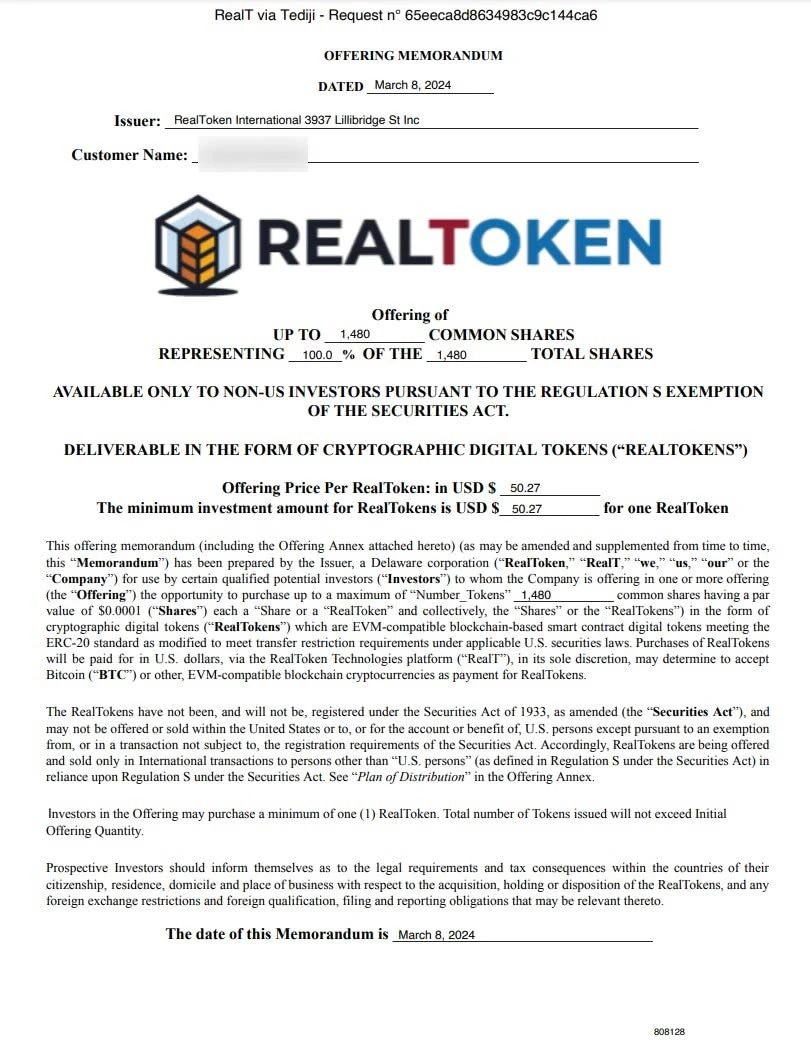
When you purchase a token, you receive an official document recognized in the United States as a security belonging to an LLC. You are on a regulated market, and despite the legal challenges faced, your token is recognized as "a Security" and therefore subject to oversight by the "Securities and Exchange Commission" in the USA. This point is very important because it ensures a certain level of robustness for your acquisition. While you may be far from your screen, not just anything can be done with a security in the United States. At worst, the asset can be sold to liquidate the LLC, and you recover your share, at market price, of course...
Click the image to enlarge.
Because yes, if RealT always offers tokens around $50, the market value of that token can fluctuate over time depending on the real estate prices in the geographic area of the property.
Therefore, in addition to your rental income, your token can gain...or lose value...and once again, you need to trust RealT not to make mistakes in its estimates.
You are entitled to resell your tokens whenever you like, either on the primary market directly with RealT (in which case it will be taxed) or on the secondary market. Once your tokens are sold, you obviously lose your rental income.
Because everything is done seriously, you also need to complete a "Know Your Customer" form. There is no money laundering or illegal use of the platform; you can invest with a smartphone, but you must provide proof of identity.
Note that RealT continues to grow and aims to cover other countries, including in Europe. You can already find offers on their marketplace in Panama and elsewhere, not just in Detroit, USA. The offer should gradually expand, but for this, RealT faces many legal challenges.
Technology and ecosystem
Initially, RealT relied on the Ethereum blockchain to operate, but very quickly, transaction fees proved to be too high.
They therefore switched to the Gnosis Chain, a less well-known blockchain, but one that has been around for a long time as a sidechain of Ethereum. It is an independent chain, but connected to Ethereum to publish data there.
Click the image to enlarge.
Feel free to read the coinacademy article on the subject
This blockchain is EVM compatible, which implies the use of smart contracts coded for Ethereum.
This has allowed RealT to expand the capabilities of its platform with two complementary solutions.
Secondary solutions
YAM
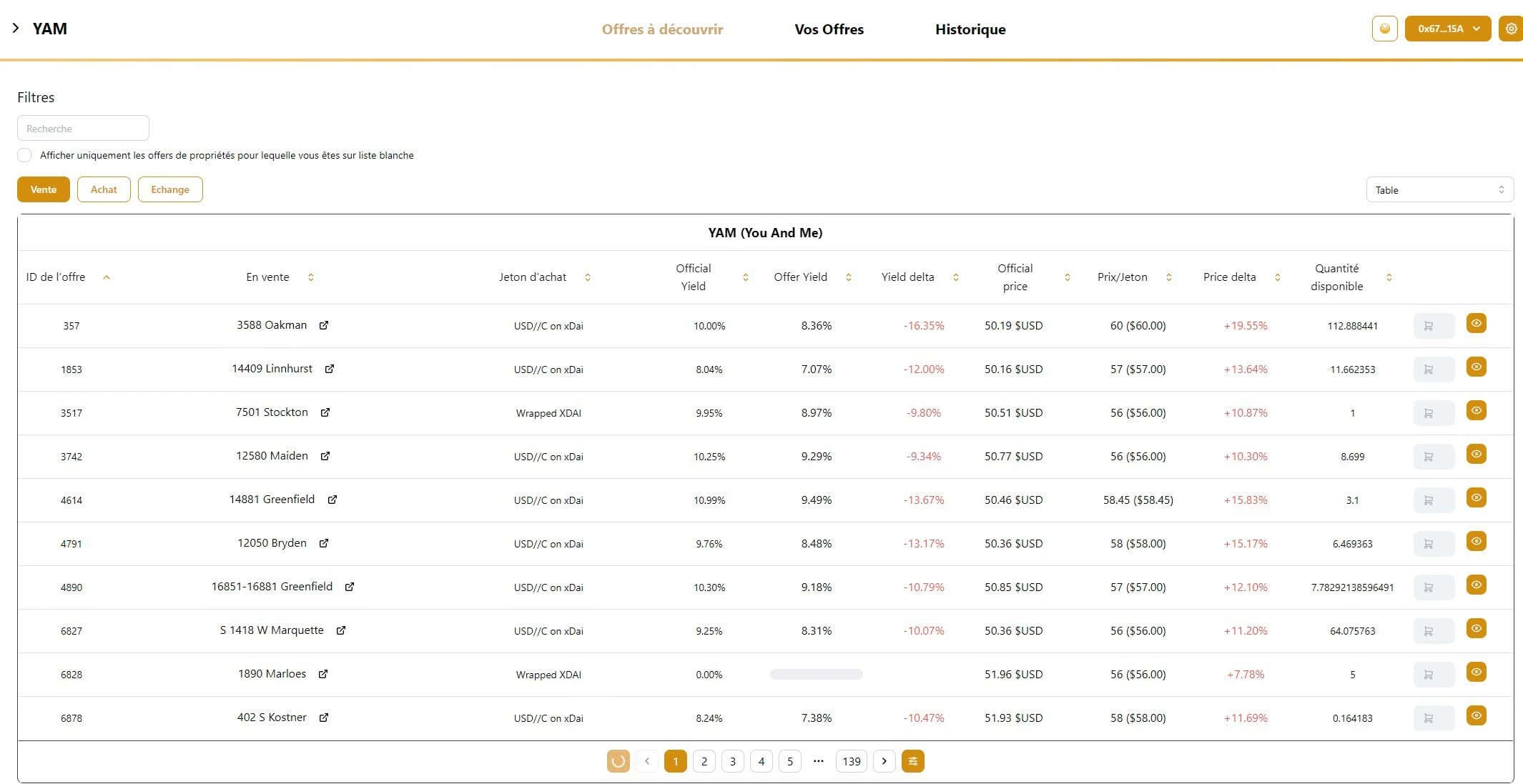
This is for "You and Me". It is a secondary market solution designed to connect sellers and buyers of RealT tokens. You can therefore sell your tokens or acquire new ones without waiting for a future sale. YAM is independent of RealT; it is the users (and therefore the market) that set the prices. However, you will always be in a regulated market, so you must be a RealT customer (i.e., have completed KYC) to interact with the solution. This is an obvious advantage of tokenization: liquidity is much higher, and it is much faster to buy/sell than in the traditional real estate market.
Click the image to enlarge.
RMM
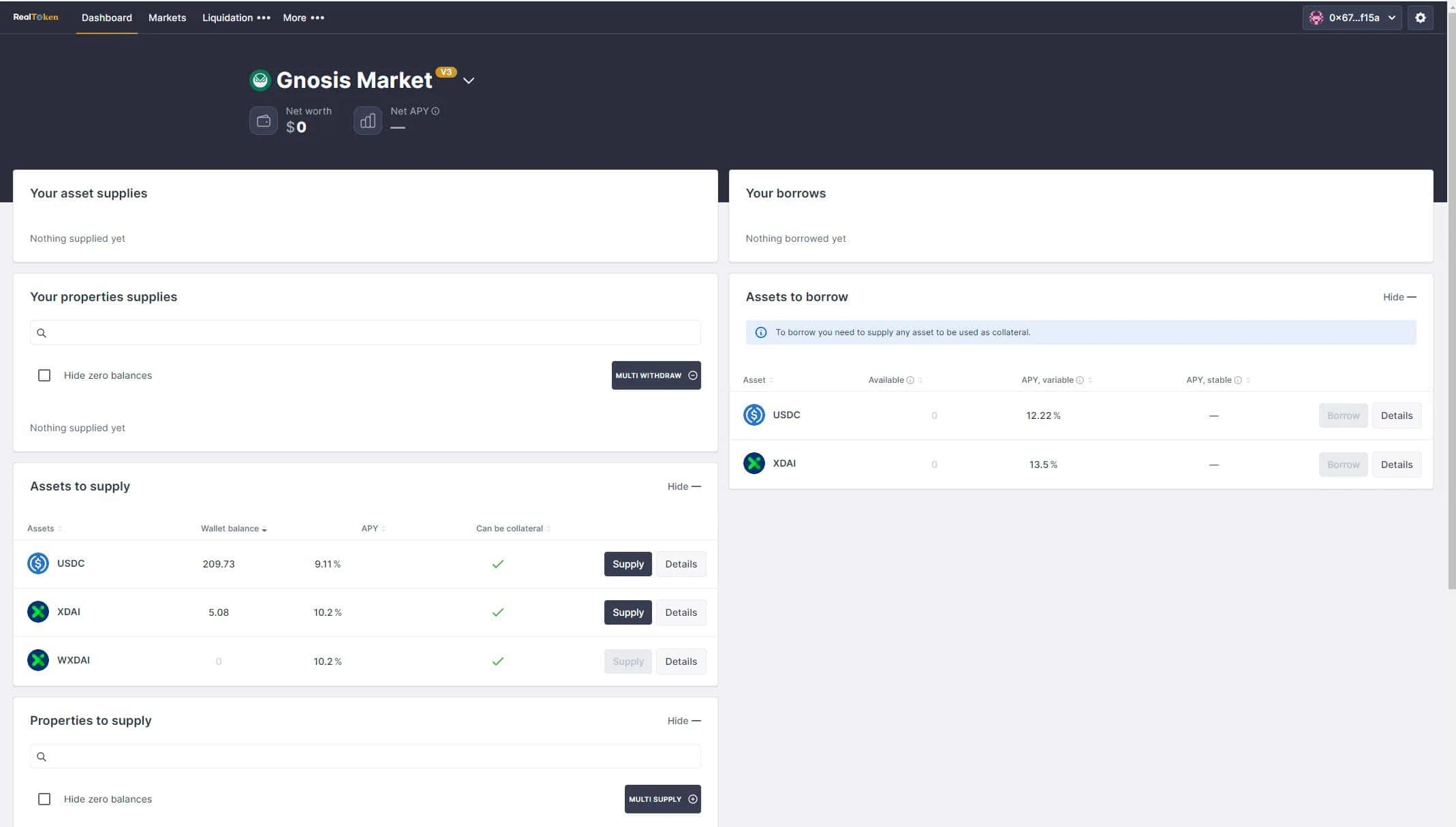
This is a solution based on AAVE that allows you to pledge your tokens to borrow stablecoins. This is a complete decentralized finance system that can help you optimize your returns depending on the risks you are willing to take. I will not elaborate further on this, as it is a specific area, but it is an extremely powerful feature of the RealT ecosystem. From a simple purchase related to real estate, you can also enter the lending and borrowing market…and still without intermediaries.
Click the image to enlarge.
Third-party tools
Finally, a community has developed around the company. RealT strongly encourages people to invest and take advantage of their technology. A large part of their code is under an open-source license. Combined with the transparency of the blockchain, this has enabled the creation of very practical third-party tools for tracking your investment.
Dashboard
The most well-known tool is the Dashboard. By connecting your wallet (or simply entering your public address), you can see details of "your real estate portfolio" and track your returns.
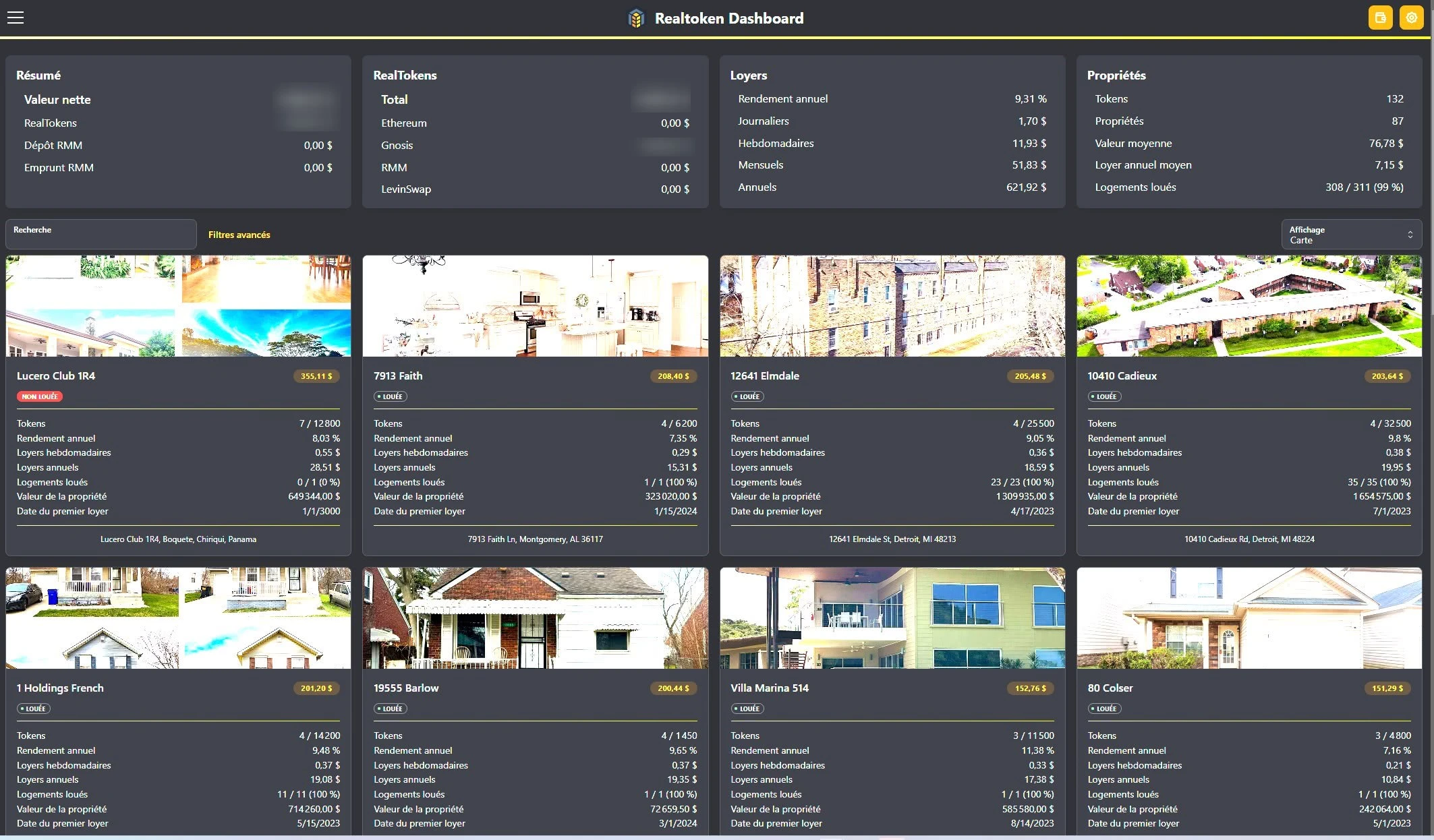
Click the image to enlarge.
Rent Tracker
The second one I use is Rent Tracker. It allows you to focus on your rental income and estimate the occupancy rate offered by RealT.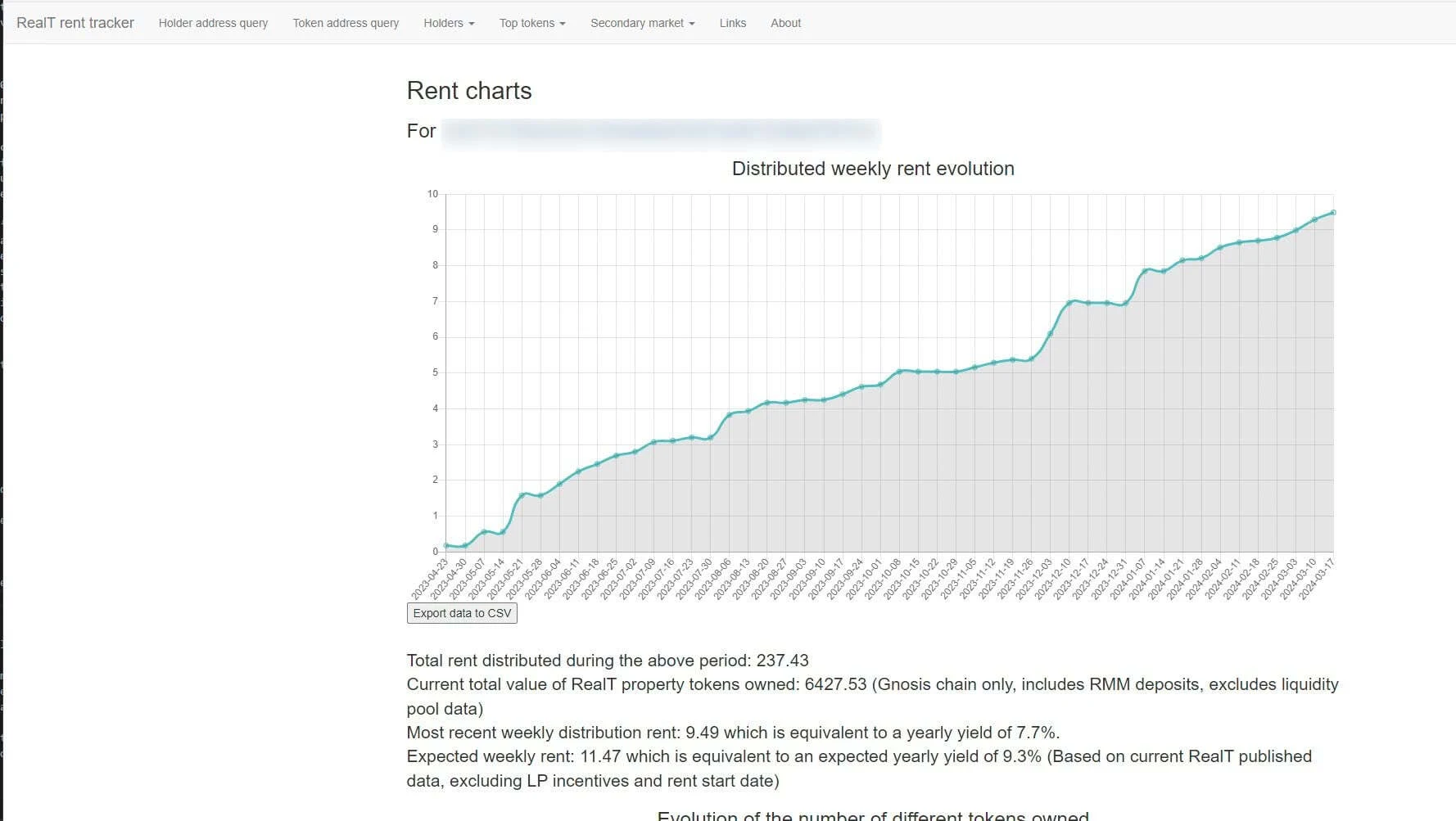
Click the image to enlarge.
Conclusions
RealT, for me, represents a genuine use case of Web 3.0. Without the emergence of blockchain technology, the concept of smart contracts, and the developing crypto ecosystems, RealT would not have been possible. Of course, buying a share of a real estate asset has existed for a long time, but being able to acquire it so easily, with minimal intermediaries and through a limited initial investment, was still impossible just 5 years ago.
Web 3.0 is not just about NFT projects featuring monkeys. Blockchain is not necessarily associated with cryptocurrency. RealT demonstrates that it is possible to use these new protocols and technologies in a meaningful way.
Maintaining a public record of a real estate asset, with copies of transactions present on over 300 nodes around the world, has never had an equivalent before.
We are only at the beginning; other innovations are coming, such as 'account abstraction,' which will further simplify the use of wallets and remove the barrier to entry that can be caused by managing a seed phrase and the private/public key mechanism.
This is the narrative of RWA (Real World Asset), where digital assets now represent a unique physical asset and make it 'manipulable' financially, thereby improving its liquidity... which is one of the challenges of Web 3.0...
RealT has recently opened up part of its capital and intends to offer its technology as a white-label solution for other uses. Investors are not mistaken; the tokens, which this time represent shares in the company, have quickly found buyers.
I would like to remind you that this is not investment advice. Please feel free to do your own research, form your own opinion, and only invest what you are prepared to lose.
Now, if you are interested and you have found my article useful, I would be grateful if you use my referral link to sign up on the platform; nothing obliges you to do so, but thank you to those who do :).