OpenClaw - Part 01: Presentation and target architecture
- From prompt to agent: autonomy, planning, and use of third-party tools.
- OpenClaw, open-source AI agent: operation and security risks.
- Target architecture: dedicated VM, rootless Podman, Vault for secrets, NGINX, Ollama.
- First part of a five-part series.
Introduction
As I described in my article on the risks of AI in business, AI is a field evolving extremely fast at an exponential pace. From simple text generation via a prompt, we have shifted to what is now called agentic AI. The difference stems from the notion of autonomy associated with an AI that includes decomposing the initial problem with planning of steps, all combined with the use of third-party tools, allowing the AI to adapt to obstacles encountered along the way. We thus move from using a prompt to using an agent.
Definition and characteristics of an agent
We sometimes tend to consider far too many things as agents. Generally, an agent can be identified by the triad Perception - Decision, Action.
An agent can only be truly qualified as such if it presents the following characteristics:
- Goal-oriented autonomy: you entrust it with an objective and it is up to it to find the associated resolution path
- Planning and reasoning capability: the agent decomposes a complex task into sub-tasks. It "thinks" before acting; we speak of ReAct frameworks for Reasoning and Acting
- Use of tools (Tool Use / Function Calling): the agent can interact with its environment and call upon tools that are accessible to it, such as a shell, internet access...
- Memory and context management: the agent must have memory to track its actions. It therefore relies on a context often associating a vector database to remember past actions.
- Self-correction: the agent must analyze the output of its actions, understand the result, and adapt accordingly until it corrects its approach if that ends in error.
In this race toward agents, one actor has experienced a stunning growth in usage: openclaw.
Click the image to enlarge.
OpenClaw
Published in November 2025 as an open-source project under the name Clawdbot by Austrian developer Peter Steinberger, it quickly gained attention.
History
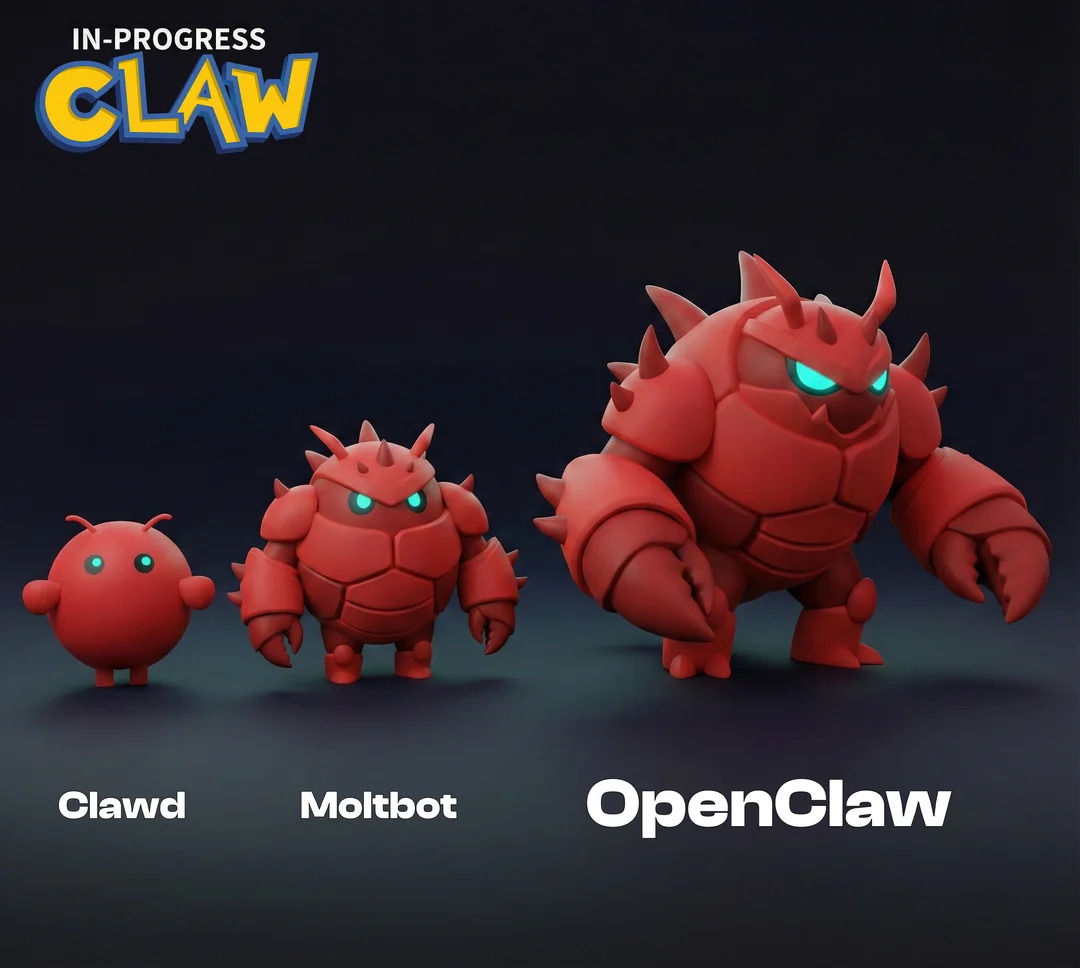
Peter Steinberger is the creator of PSPDFKit, a very popular PDF manipulation framework integrated into countless enterprise applications worldwide. Initially, the development of his agent was a purely personal project, tinkered with in his free time to meet his own need for an autonomous AI assistant capable of executing actions on his local machine. But the community enthusiasm was so great that Steinberger was forced to structure the tool and change its name under pressure from Anthropic. Indeed, the original name was a nod to Claude Code since the agent, in its first version, had been designed to interface with Anthropic's LLM engine. The tool was therefore renamed Molbot in January 2026, and continued to enjoy growing success until its second renaming OpenClaw, indicating the stabilization of the project and its agnostic nature, since it was no longer dependent on Claude.
Click the image to enlarge.
How it works
OpenClaw acts as a middleware via background operation to manage a logical flow of interaction with an LLM:
- The instruction: You send it a natural message via WhatsApp, Telegram, or Slack (e.g., "Can you check why my website is slow?").
- Reasoning (API): OpenClaw sends this text, along with the context of your machine or rather the context of your agent, to a remote language model (via API) or local (via Ollama).
- The local action: The AI understands the intent and returns not text for you, but a computer command (e.g., a curl script or shell command to test the site). OpenClaw executes this command on your machine.
- The loop (Proactivity): If the command fails, OpenClaw sends the error back to the AI so it can correct it. Once the problem is resolved, OpenClaw sends you a message on WhatsApp: "All good, I've restarted the database server."
OpenClaw includes several features:
- Native "Skills": It comes with about fifty ready-to-use tools. It knows how to manipulate a web browser (browser automation), edit local files, run Python/Node.js scripts, and use your terminal. Of course, it is possible to extend these skills via community developments.
- Omni-channel integration: It comes equipped with native connectors to the messaging platforms you already use (WhatsApp, Telegram, Slack, iMessage, Discord).
- Persistent memory: It remembers your preferences, the structure of your folders, and past conversations across different sessions.
- "Heartbeat" system (Monitoring): It can act proactively. It never sleeps, allowing it to notify you if an event occurs while you are not working.
- Sandboxing module: Safeguards to prevent it from accidentally destroying your operating system.
Conversely, OpenClaw does not possess Artificial Intelligence itself. OpenClaw is a "shell". It does not contain a native AI model. For it to be intelligent, you must provide it with access to an LLM, either remote or local.
The technical foundation
OpenClaw relies on a technical foundation leveraging TypeScript and Node.js languages. For web interactions, it includes Playwright, Microsoft's open-source tool. It also embeds a vector database for managing long-term memory (ChromaDB or SQLite with the vector extension).
In summary, OpenClaw is a large toolkit enabling the creation of an entirely autonomous execution context specific to launching an agent whose brain will be an LLM chosen by the user. A kind of Claude Code, endlessly customizable and open to various language models, not limited to code.
Security
The biggest issue with OpenClaw and what has caused a lot of noise is its security. As we saw in the history, the original project was not intended to be a standard for agent execution and was first developed as a personal project by a developer to meet his own needs. It was therefore not designed from the start to be deployed on a large scale, especially in critical contexts.
And yet, the enthusiasm and hype surrounding agentic AI have led many people, not necessarily well-trained, to deploy agents recklessly without considering security concerns. Although the situation is improving, installation does not happen through a simple executable, and if one is not careful, OpenClaw can become a real time bomb capable of accessing your entire personal ecosystem to execute a whole set of actions. Not to mention, hackers quickly exploited the phenomenon by offering poisoned skills or inviting users to provide their personal data, API keys, and other logins.
We saw instances of OpenClaw flourish on unsecured VPSs or via simple remote commands, where it was possible to prompt the agent and make it do whatever they wanted with the identities registered by the user. Some, therefore, simply exposed their servers and computers through OpenClaw along with all necessary credentials and access to allow an attacker to perform all actions authorized for the agent's operation.
Competitive solutions have emerged by exploiting OpenClaw's lack of security. Nvidia's initiative, Nemoclaw, is an example of these alternatives. It is an improved version of OpenClaw that includes an application firewall allowing precise control over permissions and the scope of access granted to the agent. In the same vein, we can mention the concept of Nanoclaw, which uses containerization technology to confine agents in controlled environments.
Click the image to enlarge.
Click the image to enlarge.
While these alternatives are very interesting, this overlooks the fact that OpenClaw has evolved too. Significant work has been done on security. Although the user still bears a large share of responsibility, the tool integrates security in a more mature way. We can cite, for example, the partnership with VirusTotal to protect skills made available to the community. Personally, I tried both Nemoclaw and Nanoclaw, but neither has OpenClaw's compatibility and functional richness for the time being.
Chosen architecture
I have therefore decided to follow a different approach.
Dedicate a VM to the installation of multiple agents executed by OpenClaw, but containerized and isolated from each other, like nanoclaw. Moreover, all critical authentication elements required by the agents will be stored in Vault, a leading tool for managing sensitive information. I could thus combine the richness of OpenClaw with the security of more recent solutions to create a true agent platform within my homelab.
For an entirely internal solution, I will rely on local LLMs executed by Ollama, a tool I have already presented. Only remote interaction will leverage third-party software, namely Telegram. I would have preferred Signal, but for now, it is a bit too constraining.
I therefore propose to embark on a series of articles detailing the setup of this architecture. The objective is to design a first agent IT-Claw intended for the monitoring of my homelab, particularly my Kubernetes cluster. This first agent must be able to serve as a repeatable procedure for other agents while maintaining this same logic of isolation and security. Note, I do not guarantee a flawless solution; it is possible that despite my efforts, vulnerabilities may remain open. I will strive to do my best and will, of course, always be open to criticism.
Component details
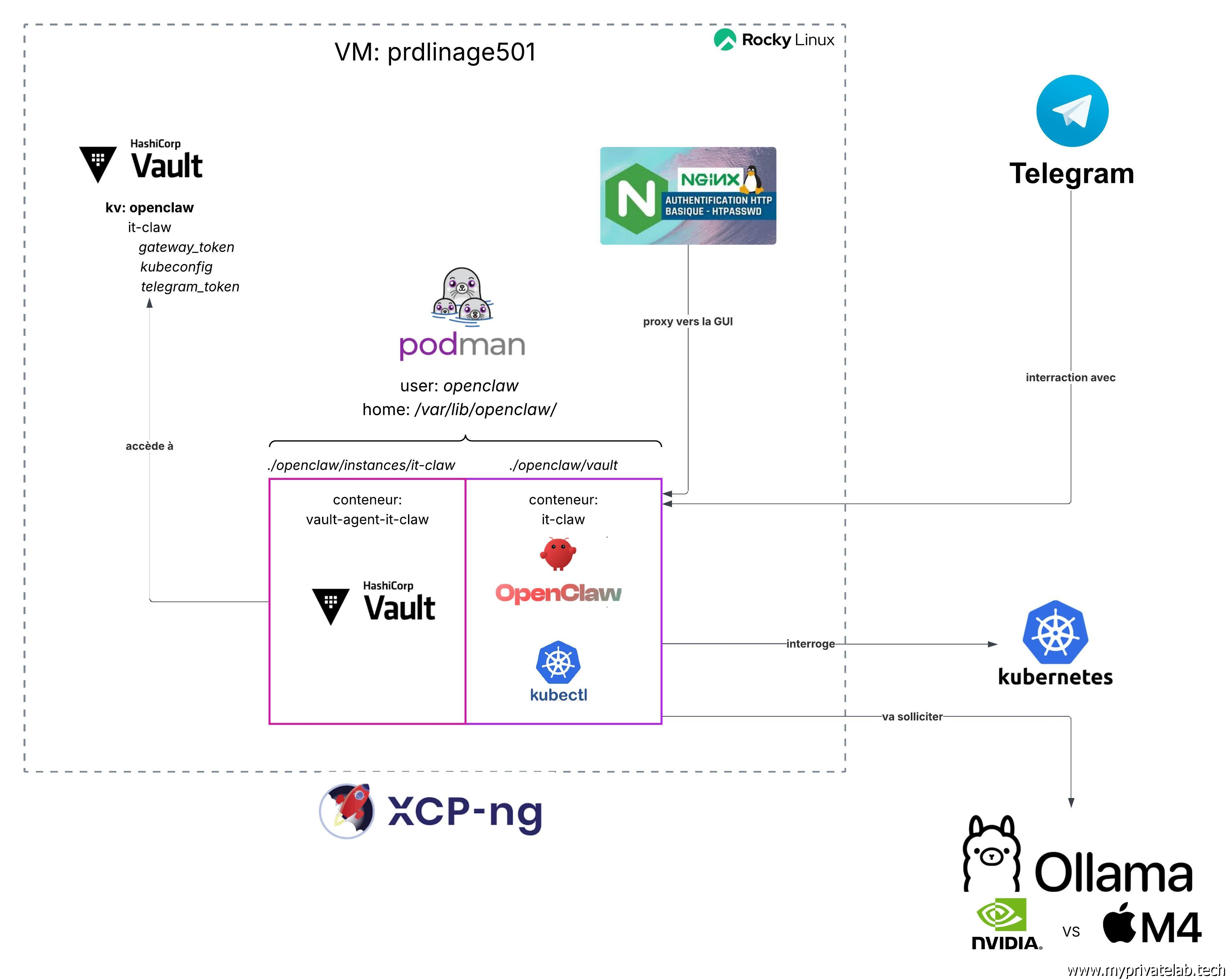
As usual, we will start by presenting the architecture to be implemented and detailing the components. We will therefore deploy a VM under Rocky Linux 10, prdlinage501, which will be executed on XCP-ng.
Click the image to enlarge.
In this virtual machine, we will install Vault and enable the KV (key-value) functionality to store secrets. This will allow for a secure environment to store sensitive information.
Each containerized AI agent will have access to its own branch within this KV via a containerized Vault agent (the client part of Vault). It is somewhat the principle of a sidecar, meaning that an OpenClaw instance will receive the secrets it needs thanks to a Vault agent instance responsible for communicating with the KV branch containing the secrets of the AI agent in question.
It is Podman that will be chosen as the container engine. The fact that it is rootless will further increase the level of isolation and security.
Container management will be possible via a specific account on the Linux machine, namely the openclaw user which will operate within its own home directory (/var/lib/openclaw). This home will also serve as the root location for each tree to be mounted into the AI or vault containers.
Regarding the first agent IT-Claw, it will be executed from an image generated by us and including the kubectl binary. It will thus be able to act on the Kubernetes cluster.
The configuration of kubectl will be stored in Vault and will be associated with a specific service account having only read-only rights on the cluster (except for objects of type "secret k8s" which will be forbidden to it).
The LLM will be hosted on an Ollama instance, which can either run on my personal workstation equipped with an NVIDIA GPU or on a MacBook Pro M4; this will also allow comparing multiple models and multiple hardware setups for local AI.
Finally, a Telegram bot will serve as an interface to interact with the AI agent. The Openclaw GUI will be accessible via a reverse proxy NGINX integrating basic authentication. (The latter can subsequently be linked to an OAUTH2 authentication via a corporate IDP.)
Conclusion
Now that we know where we are going, it's time to get started. But for that, we need to head to the next article.